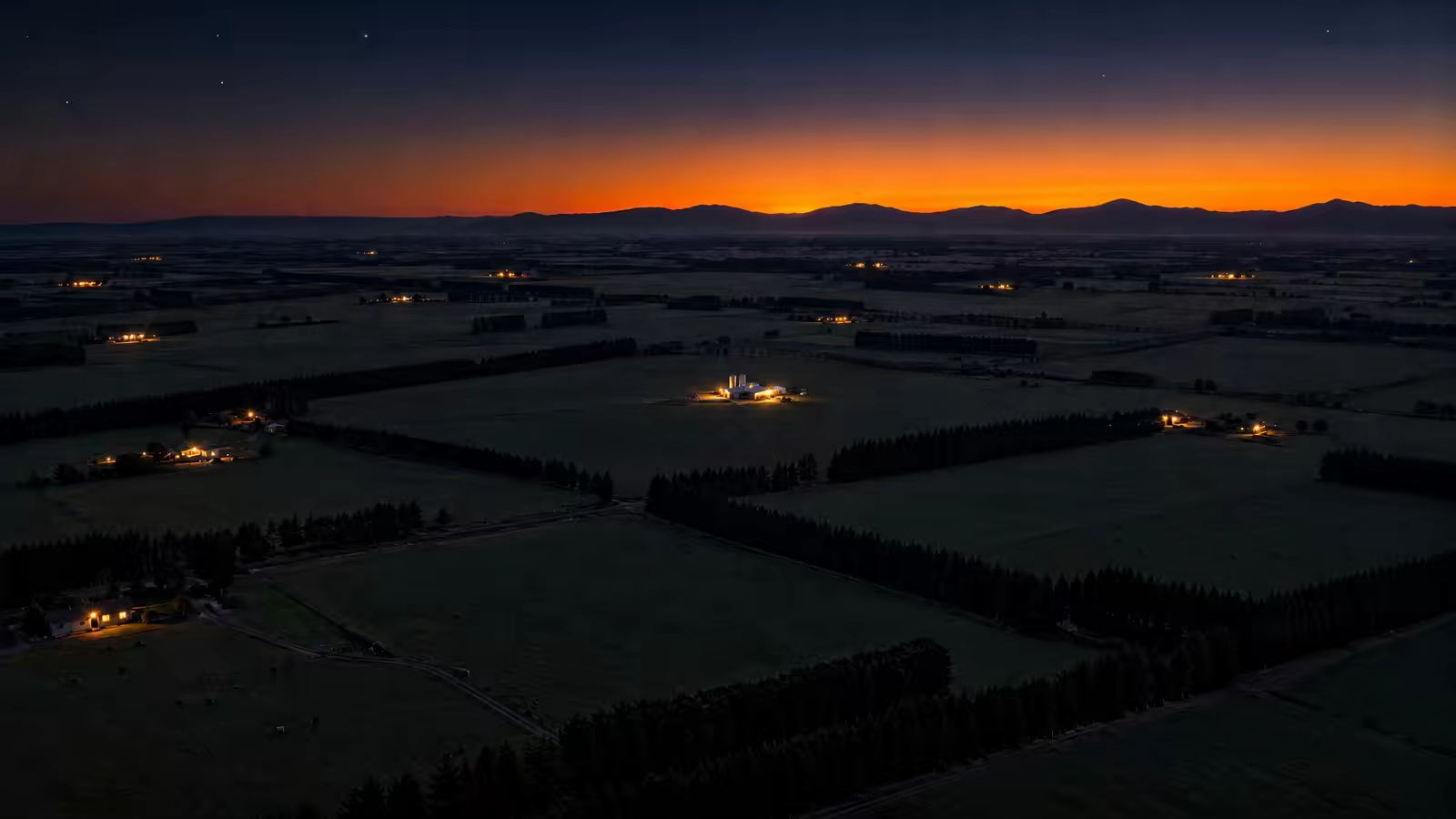
Solar for New Zealand farms, growers and producers
Before sunrise, the milking runs on bought power.
We start with twelve months of your power bills.
Then we size the system, and the finance to fund it.
The sun comes up. The bill comes down.


After sunrise, the farm can make its own.
Power made on the farm is power the farm doesn’t have to buy. Take enough of it off the bill, across enough farms, orchards and packhouses, and it costs less to produce food in New Zealand. That is the whole idea.
Your numbers
These were an example farm’s numbers. Put in yours.
The calculator starts where the film ended (Southland dairy · $3,500 a month). Change anything. Thirty seconds, no contact details needed, conservative assumptions disclosed in full.
Your farm or business
Your indicative numbers
Conservative, ex GST, modelled not promised
Measure
- Power used
- 164,706 kWh a year
- Your spend at 25.5c a kWh ex GST, the national commercial average.
- Power bill
- $42,000 a year
Design
- System
- 59 kW
- Sized to your daytime load.
- Generates
- 67,260 kWh a year
- Used on site
- 70%
- The rest exports at 8c a kWh.
- Installed cost
- $96,423 to $133,846
- Confirmed with certified installers.
Finance
- Investment Boost, year one
- about $6,448
- A 20% immediate tax deduction, worth this in cash at the 28% company rate. Not a discount.
- ASB Smart Solar Loan
- $1,919 a month
- 0% for 5 years. Reverts to a floating business rate after five years. Terms checked against asb.co.nz on 9 October 2026. ASB may change or withdraw the offer; the calculator only shows it while it matches.
- Estimated saving
- $1,035 a month
- Mid estimate, set against the repayment while the loan runs.
Outcome
- Saving
- $11,219 to $13,620 a year
- Payback
- 6.5 to 11.5 years
- Net of the Investment Boost benefit.
- Emissions avoided
- 3.5 t CO₂e a year
- Asset life
- 25+ years
- Panels keep producing long after payback.
How this is modelled (assumptions v2026-10-v7)
- Power valued at $0.20 to $0.26/kWh ex GST (savings are never valued at the top of the commercial tariff range).
- Export credited at $0.08/kWh, the conservative end of current buy-back rates.
- Installed cost interpolated from 30 kW ($1,800 to $2,600/kW) down to 500 kW ($1,100 to $1,500/kW), 2025/26 working ranges.
- Southland yield modelled at 1140 kWh per kW per year.
- Self-consumption capped by your daytime usage profile and held below typical vendor claims; sizing targets 90 percent of daytime load.
- Investment Boost stated as the year-one cash value of the 20 percent immediate deduction at the 28 percent company rate. It is a tax timing benefit, not a discount.
- No power price escalation and no panel degradation in simple payback; omitting escalation outweighs degradation, so the net effect is conservative.
Indicative only; not financial or tax advice. The feasibility study models your site from twelve months of actual bills.
Next step
Get these numbers checked properly
The real model is built from twelve months of your bills. Send your details and we will do it for you; we reply within one working day, no obligation.
The method
What you just watched is how every project runs.
01
Measure
Twelve months of your power bills give us the load, the tariff and the seasons. Nothing is sized from a rule of thumb.
You get
Feasibility study
02
Design
The system is sized to the power you use in daylight, not to the size of the roof, so most of what it makes is used on site.
You get
Proposal: system, cost, savings and payback
03
Finance
We stack the Investment Boost deduction with green or interest-free business lending, and show the repayment next to the saving before you sign.
You get
Lending arranged
04
Build and monitor
SEANZ-certified local crews install it while we handle approvals and certification. Then we measure the savings against the model.
You get
Savings report, every year
Who it is for
Farms, growers and the businesses that process what they grow.
Each page models one kind of operation in one region, with the sun that region actually gets. For the overview, start with farm solar or commercial solar costs; for storage, see when a business battery pays.
- Dairy farmsCanterbury1,310 kWh per kW a year
- Dairy farmsCoastal Otago1,220 kWh per kW a year
- Dairy farmsSouthland1,140 kWh per kW a year
- Orchards, packhouses and coolstoresNelson Tasman1,330 kWh per kW a year
- Cold stores and packhousesCanterbury1,310 kWh per kW a year
- Orchards, packhouses and cold storesCentral Otago1,220 kWh per kW a year
- WineriesMarlborough1,390 kWh per kW a year
- WineriesCentral Otago1,220 kWh per kW a year
- IrrigationCanterbury1,310 kWh per kW a year
- Aquaculture and seafood processingMarlborough1,390 kWh per kW a year
- Manufacturing and logisticsCanterbury1,310 kWh per kW a year
- BusinessesChristchurch1,310 kWh per kW a year
Yields are what our model uses for each region: kWh a year from each kW of panels, derated from PVGIS satellite irradiance for real commercial installs.
The hard questions
Every reason to say no, answered with numbers.
- What does it cost up front?
- Often nothing: green or interest-free business lending can fund the install. The Investment Boost then lets a company deduct 20% of the cost from taxable income in the first year, with normal depreciation on the rest. On the example farm that is worth about $6,400 in year-one cash at the 28% company rate. It is a tax deduction, not a discount.
- Will the repayments hurt cash flow?
- We put the repayment next to the saving before you commit. On the example farm the ASB Smart Solar Loan is $1,919 a month for 5 years, against a saving of $935 to $1,135 a month. Once it is paid off, the saving is yours for the rest of the system's 25-year modelled life.
- What about the payback?
- It depends most on how much power you use in daylight. The example farm, with chilling, hot water and effluent pumping through the day, pays back in 6.5 to 11.5 years on the calculator's conservative settings. A farm that milks and heats water mostly before dawn does worse; sites with steady daytime cooling or pumping usually do better. We model yours from your bills before you spend anything.
- Does Southland get enough sun?
- Less than Central Otago, and our model says so: we use 1,140 kWh a year from each kW of panels in Southland against 1,220 in Central Otago. Long summer days carry the year, and the dairy season's spring and summer peak runs with them.
- What happens to power we don't use?
- It goes to the grid, for about 8 cents a kWh in our model, against the 20.4 to 25.5 cents each kWh saves when it is used on site. That is why we size to your daytime load rather than your roof.
- Why not just call an installer?
- You can. We are not an installer with panels to move: we model your site independently from your own bills, arrange the finance, and project-manage SEANZ-certified local crews, so one party answers for the whole result.
Example farm figures: Southland dairy · $3,500 a month in power · daytime chilling, hot water and effluent, modelled with our calculator (assumptions 2026-10-v7). Ex GST, indicative, not financial or tax advice.
Send a year of bills. Get the model.
An independent feasibility study on your own numbers: system size, cost, savings, payback and the finance to fund it. No obligation, and yours to keep.